All About Tomatoes
The modern age of the tomato was ushered in by hybrids such as Big Boy, which is still offered today. The early ripening red tomato was an instant success. Thousands of hybrids have followed, offering gardeners desirable traits such as earliness, crack-resistance, and compact habits. Continued breeding efforts have produced more healthful tomatoes with increased lycopene, and plants with multiple disease resistances in addition to improved taste and texture.
Each AAS Winning Tomato has been trialed for superior taste, disease resistance, and overall better qualities to the comparisons. The varieties that an AAS Winner is trialed against are the best in “its” class for the same desired traits. Therefore you know that when you grow an AAS Winning Tomato, the Proof is in the Plant!
Classifications and Colors for Tomato Types
Tomatoes are classified in a number of different ways, including fruit shape, days to maturation, and color.
From smallest to largest, popular fruit shapes are identified as currant, cherry, grape, cocktail (or saladette) plum, standard/slicer, and beefsteak. Two- to three-bite saladettes, such as the AAS Winner Red Racer, Valentine and Juliet, are larger than cherry but often smaller than plum tomatoes.
Fruit colors range from creamy white through lime green, to pink, yellow, orange, and red and even purple.
Pink, yellow, and orange are milder tasting than most red varieties. Contrary to popular belief, yellow tomatoes are not lower in acids. Rather, it is the balance of acids, sugars, and aromatics that distinguishes the taste of one tomato from another.

Tomato Red Racer F1
~ Saladette (cocktail)
~ Determinate
~ Container Suitable

Tomato Juliet F1
~ Saladette (elongated cherry)
~ Indeterminate
~ Produced in clusters

Tomato Valentine F1
~ Saladette (grape)
~ Indeterminate
~ Works well in summer heat

Tomato Red Torch F1
~ Oblong size
~ Indeterminate
~ Striped

Tomato Midnight Snack F1
~ Cherry size
~ Indeterminate
~ Indigo color

Tomato Candyland Red F1
~ Currant size
~ Indeterminate
~ Nice tidy habit
Growth Habit for Tomato Types
Determinate Tomato Type
These tomatoes are compact and reach a predetermined height and/or number of fruit clusters.
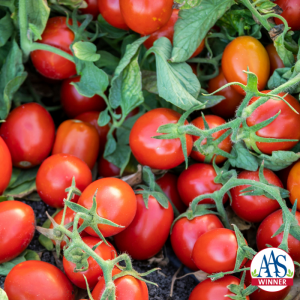
Tomato Early Resilience F1
~ Roma size
~ Determinate
~ Container suitable

Tomato Galahad F1
~ Beefsteak
~ Determinate
~ Disease resistant

Tomato Patio Choice Yellow F1
~ Cherry size
~ Determinate
~ Container suitable
Each short branch of the determinate tomato ends in a flower cluster, and plants do most of their growing before setting fruit.
Determinate tomatoes tend to ripen all at once, so the main harvest ripens in a few weeks. This may be ideal for gardeners who wish to preserve fresh tomatoes. Early Resilience, Galahad, Patio Choice Yellow, Fantastico, Mountain Merit, and Lizzano are all determinate AAS winning tomato varieties.
Indeterminate Tomato Type
Indeterminate tomato plants grow, blossom, and produce tomatoes throughout the growing season.

Tomato Chef’s Choice Green F1
~ Beefsteak
~ Indeterminate
~ Green with subtle yellow stripes

Tomato Chef’s Choice Orange F1
~ Beefsteak
~ Indeterminate
~ Orange

Tomato Chef’s Choice Black F1
~ Beefsteak
~ Indeterminate
~ Dark green/brown/black hue

Tomato Mountain Rouge F1
~ Beefsteak
~ Indeterminate
~ Disease resistant

Tomato Firefly F1
~ Size between cherry and currant
~ Indeterminate
~ Pale white to pale yellow

Tomato Jasper F1
~ Cherry size
~ Indeterminate
~ Overcome weather related stresses
Indeterminate tomatoes can reach up to 12 feet tall (but 6 feet is more common), and produce many main stems, all of which are capable of flowering and fruiting.
An example of an indeterminate variety is AAS winners in the (beefsteak) Chef’s Choice series along with Mountain Rouge, Firefly, and Jasper. To support growth and to keep tomatoes off of the ground, using stakes or cages is recommended.
Staked plants should be pruned to remove all but two growing stems, which are tied loosely to the stakes and trained for vertical growth. Because this system allows air to circulate around the plants, it can help prevent disease. Pruning, although not strictly necessary, can produce larger but fewer tomatoes.
Semi-determinate Tomato Type
Semi-determinate plants are bushy like a determinate but will set and ripen fruit over a longer period of time.

Tomato Celano F1
~ Grape size
~ Semi-determinate
~ Container suitable

Tomato Celebrity F1
~ Medium-large slicer
~ Determinate/Semi-determinate
~ Disease resistant
The AAS Award Winners Celano is considered semi-determinate.
Celebrity is often considered semi-determinate because the plant grows to a certain height (3 to 4 feet) but continues to produce fruit all season until frost.
The best way to grow determinate or semi-determinate plants is to not prune and place a cage around the tomato while still small.
Growing Tips for All Tomato Types


Many gardeners start their tomato plants from seed, which allows them a much wider choice of tomato varieties than a garden center is likely to offer.
- Sow indoors about 6 weeks before the last expected frost date.
- Use a sterile germination mix and make sure the planting tray has holes for drainage.
- Moisten the growing mix and sow the seeds, covering lightly. (Note, with the high germination rate of AAS Winners, do NOT overplant. One seed per cell should be plenty with new seeds.)
- Keep the planted tray from drying out by misting or covering gently with plastic, and for maximum germination, warm the soil to 70 to 75 degrees F by placing the tray on a heat mat or other warm surface.
- Remove the cover when most of the seeds have sprouted and place in a warm sunny location.
- After they develop at least one set of true leaves, transplant to individual pots filled with soilless planting mix.
- After “resting” in low light for a day, young plants will need as much direct sunlight as possible—twelve hours a day is desirable—to keep them from becoming leggy. Supplemental grow lights are recommended.
Hardening off
It is important to harden off tender plants before placing them in the garden by exposing them gradually to harsh outdoor conditions. Put young plants outside where they will receive morning sun but protection from wind and move them inside at night. Continue this for about a week, and then begin to leave them outside on nights when the temperature does not drop below 50 degrees F. After a week or two, the plants should be ready to transplant.
Planting
Tomatoes need as much direct sunlight as possible to produce the highest yield. Native to the tropics, tomatoes require warm temperatures for good growth, so wait until the nighttime air has warmed to about 55 degrees F before transplanting them. Planting tomatoes too soon will only slow them down.
If temperatures drop at night, keep young plants warm with a cloche or other protective cover. Tomatoes are not frost hardy and will die if exposed to 32 degrees F without protection.
Continue watering regularly for about two weeks until the plants are established. Throughout the growing season remember to water the plants deeply during dry periods for as long as they are setting fruit. Established tomato plants need at least one inch of precipitation per week.
Plant Nutrition
Tomatoes need phosphorus, nitrogen, potash, and minor elements. Starting your plants off with an ample shovelful or two of compost will help the soil provide for their needs. Many gardeners also add synthetic or organic fertilizer. Some types, such as water-soluble granules or fish emulsion, can be applied when watering. There are also granular forms that are mixed with the soil before planting or used as a side dressing, and time-release fertilizers, which can be added to the soil at planting time. No matter what kind of fertilizer you use always follow the directions on the label.
Do not over-fertilize as this will cause lush plants with little fruit set. It’s best to select a fertilizer that contains more phosphorus (P) than nitrogen (N) or potassium (K) because phosphorus promotes flowering and fruit set.
Container Culture
Tomatoes can also be grown in tubs or large patio containers. For best results select a variety with a compact or determinate habit. The container needs to be at least 12” deep, with drainage holes on the bottom. Use a sterile growing mix, keep the plants evenly watered, and place them in a sunny spot. Feed plants regularly with a water-soluble fertilizer, keeping in mind that nutrients will leach out of the pots faster than garden soil. During periods of hot weather, full-grown plants may need to be watered daily.
Harvest
For the best tomato flavor, allow the fruit to fully ripen on the plant. Wait until it is deep red, yellow, or whatever final color the tomato is to be because once removed from the vine, the supply of sugars is cut off. To harvest, gently twist the fruit so that the stem separates from the vine. Tomatoes are best kept at room temperature and will store on a kitchen counter for several days. It is absolutely unnecessary to place a ripe tomato in the refrigerator.
At the end of the season when frost is predicted, green tomatoes can be harvested and placed on a windowsill or counter. Most will gradually turn red and have some degree of tomato flavor. Placing unripe tomatoes in a paper bag will hasten the ripening process.
Read more about AAS Winning Tiny Tomatoes
Learn more about our AAS Winners and Growing Tips on our AAS YouTube Channel
Which AAS Winning Tomatoes are you going to plant?
“This post is provided as an education/inspirational service of All-America Selections. Please credit and link to All-America Selections when using all or parts of this article.”